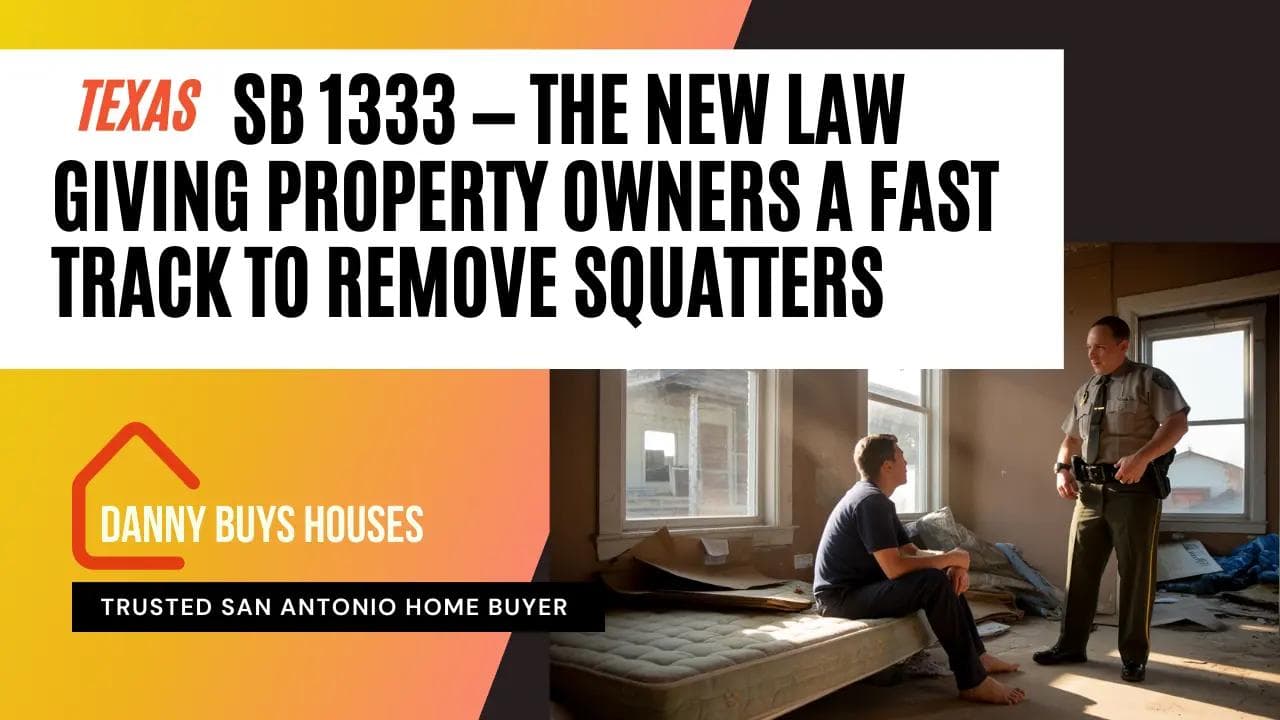
Texas SB 1333 — The New Law Giving Property Owners a Fast Track to Remove Squatters

By Danny Johnson | Updated 3/10/2026, 1:10:52 PM
Texas Governor says squatters have taken advantage of eviction laws for too long. Find out what changes have already taken effect to quickly remove squatters.
- The Problem That Drove the Legislation
- What SB 1333 Does
- Penalties for Document Fraud
- Who Is — and Isn't — Covered
- Protections and Guardrails
- Self-Help Evictions
- Proof of Ownership
- What Property Owners Should Do Now
- Conclusion
🗂 Table of Contents
Governor Greg Abbott signed SB 1333 into law, stating that Texas was facing a "squatting crisis" and that "private property rights are a cornerstone of our Texas values."
In a nutshell, Texas Senate Bill 1333 allows sheriffs and constables to take action immediately when a property owner provides a sworn complaint that someone has taken possession of their real property unlawfully. In the past, property owners would have to follow eviction procedures to remove squatters.
This has become a huge frustration for many homeowners as Texas has seen a rapid increase in squatting cases, with Dallas-Fort Worth ranking second in the nation, according to a survey by the National Rental Home Council.
SB 1333 represents a fundamental shift — moving squatter removal out of the courts and into the hands of law enforcement.
The Problem That Drove the Legislation
Homeowners have been bearing the burdens of evicting people who unlawfully entered and have taken possession of their property. The problem is not just a burden on homeowners but also a strain on the court system in many jurisdictions.
A Mesquite homeowner returned after seven months of emergency travel to find squatters had damaged her walls, floors, and left rooms filled with drug paraphernalia and rotten food — and it still took another 60+ days after a court date to finally remove the occupant, as recounted in the Houston Public Media.
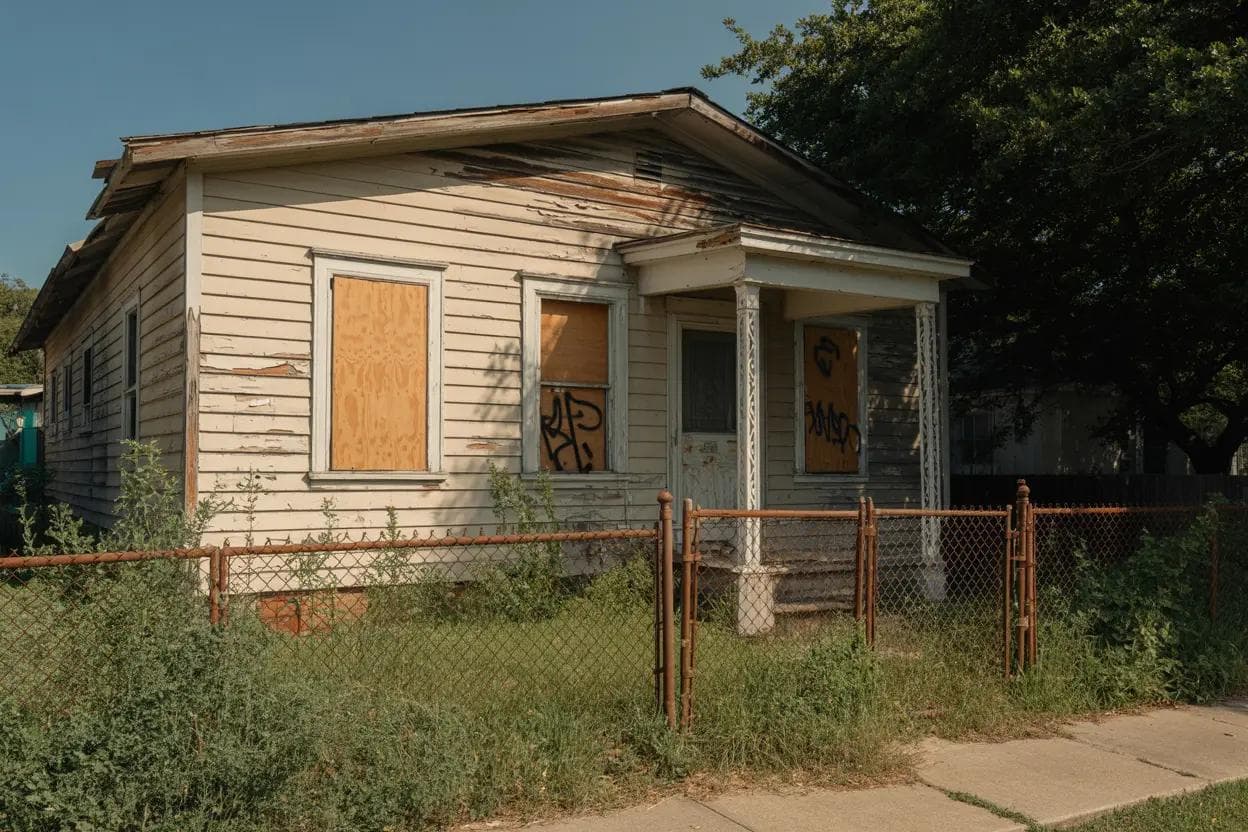
I had my own situation involving a squatter that knew all of her "rights". I was meeting a contractor at a vacant rental property in the Los Jardines area in the near westside of San Antonio and noticed a cup outside the garage apartment. My heart sunk. I had just spent months evicting tenants from the main house. After some knocks on the door, a woman answered wrapped in a towel. She was not nervous. When asked what she was doing, she responded, "taking a shower." After clarifying that I meant what she was doing living in the apartment, she said she had every right to just move in and live there. She then started reciting different city ordinances and codes. Ugh. This was going to be a problem. And it was.
My attorney informed me I had to provide all sorts of notices that stated she did not have to vacate and all of the rights she had. I remember thinking how crazy it all seemed. Was this the new reality? Could it really be the case that you could simply move in to any property and claim it as your right? Not exactly. But it felt that way.
The elderly neighbor asked me what I was going to do as she was scared for her safety as she lived alone and the squatter was having people over at all times of the night.
Prior to SB 1333, we had to:
- file a formal complaint with the Justice of the Peace Court
- serve the squatter with a citation
- hold a formal hearing
- obtain a writ of possession from a judge before enforcement could take place
I was also told I was not allowed to turn off utilities to the property. Under Texas Property Code § 92.008, interrupting utilities (water, electricity, gas) to force occupants out is illegal, even if they have no lease.
What SB 1333 Does
According to Texas.gov, SB 1333 empowers sheriffs and constables to take action quickly when a property owner submits a sworn complaint that a squatter has taken possession of their property unlawfully.
SB 1333 took effect on September 1, 2025.
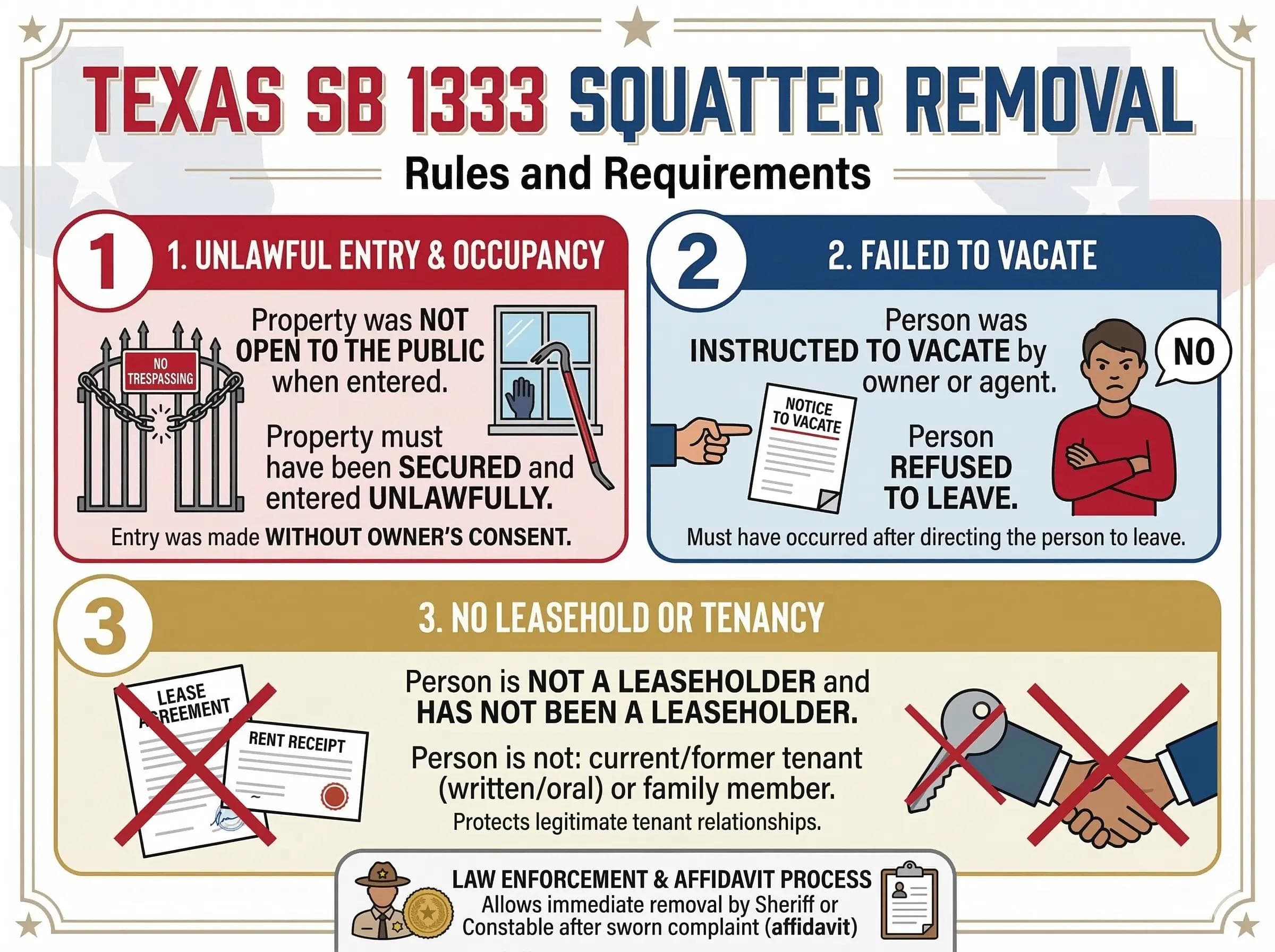
There are 3 conditions for quick removal allowed by SB 1333:
- Property must not have been open to the public. It must have been secured and entered unlawfully.
- Person must have been instructed to vacate and refused.
- Person must not be or have been a leaseholder.
Penalties for Document Fraud
The bill also covers penalties for document fraud. According to Texas Scorecard, the measure creates felony penalties for those who knowingly create false documents to convey ownership or leaseholder status, or who advertise, rent, or sell a property without legal title and authority.
Who Is — and Isn't — Covered
Only true squatters are allowed to be removed with SB 1333. If you have implied permission to be in the property, the bill does not relate to you.
Tenants with current or expired leases cannot be removed with SB 1333. The landlord will need to follow normal eviction processes.
Family members are not included and will also need to be removed through the eviction process.
Only residential buildings apply. Commercial properties are not covered.
Basically, if you are an unauthorized person in a residential building, and are not a family member of the owner, you can be removed with SB 1333.
Protections and Guardrails
There have been concerns about this bill being abused to remove people quickly that are eligible but denied court proceedings.
According to the Texas Public Policy Foundation, individuals who are wrongfully removed are entitled to sue the owner for actual and exemplary damages, three times the fair market rent, court costs, and attorney fees.
This will go a long way to ensuring abuse does not happen.
Self-Help Evictions
Self-help evictions are where property owners remove people from their properties without following the proper process. They are illegal in Texas.
SB 1333 does not change the legality of self-help evictions. Owners must still follow the correct process for each situation.
Proof of Ownership
Owners will need to provide documentation showing true ownership when they file a sworn complaint. This will ensure people aren't wrongfully being removed by someone that does not even own the property.
What Property Owners Should Do Now
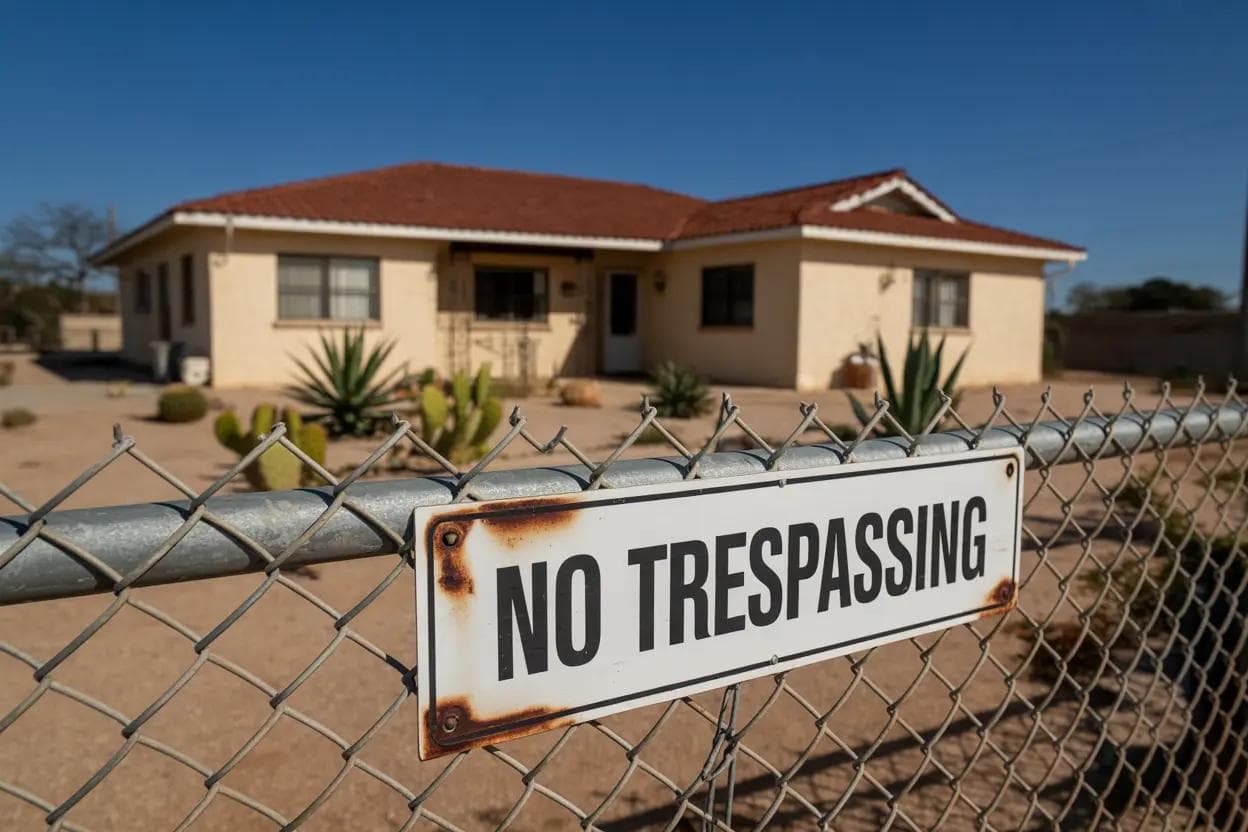
First, if you have vacant property, do all you can to ensure the property is secured. Post 'No Trespassing' signs. Install cameras. Document and take pictures showing the property is secured.
Get in touch with your local sheriff or constable's office to find out what the local procedures are if you have a squatter.
Never do remove people on your own. Always file a sworn complaint and follow the process.
Provide written directive to vacate and document this and the refusal to leave.
If the occupancy is ambiguous, be sure the consult with an attorney.
Conclusion
It is great to see that property rights are being protected. The pendulum had swung to far to one side and now coming back to center. We have to be diligent to ensure the pendulum does not swing too far the other way.
In order to do this, we have to follow the procedures as outlined here. Abuse will cause more legislation. In my opinion, the less legislation the better. This only works if we all act in lawful and responsible ways.
If you have a house that has been damaged and you have no desire to mess with it, give us a call. We buy houses as is.

AUTHOR
Danny Johnson
Owner and Founder at Danny Buys Houses
Danny Johnson is an experienced real estate investor who has been buying houses for cash since 2003. As owner of Danny Buys Houses, Danny's goal is to help homeowners sell their house fast, regardless of the situation, so they can move on with their life.
Danny has been featured in publications such as Forbes, Realtor.com, BiggerPockets, Yahoo Finance, US News, and more. He is also the author of the book 'Flipping Houses Exposed'.